Critical WPIDE Plugin Flaw Lets Attackers Execute Code Without Authentication
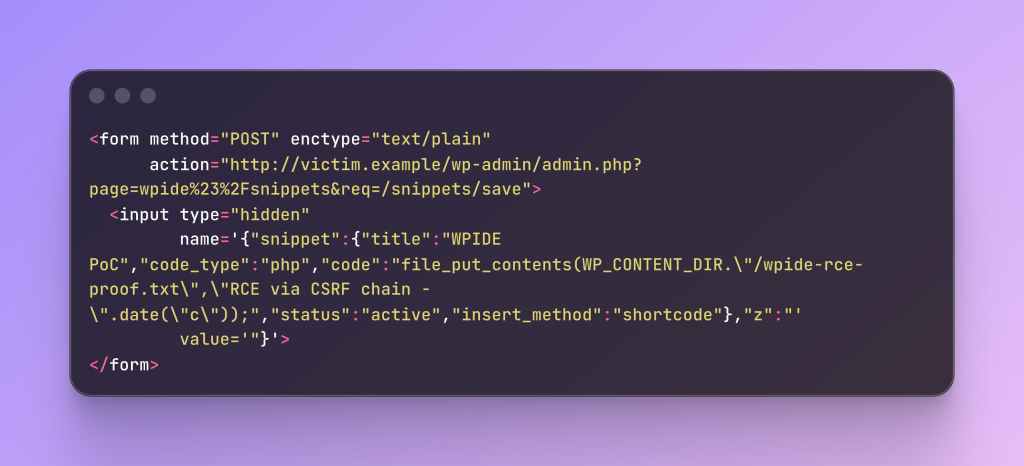
Security researchers have identified a high‑severity flaw in the WPIDE – File Manager & Code Editor plugin for WordPress that enables unauthenticated remote code execution, prompting urgent calls for site owners to update.
The vulnerability stems from a cross‑site request forgery (CSRF) nonce bypass that affects versions 3.6.0 through 3.6.4 of the plugin. Testing confirmed successful exploitation on releases 3.6.0, 3.6.1 and 3.6.2, and the issue has been catalogued under CVE‑2026‑124251 with a CVSS v3.1 score of 8.8, indicating critical impact across confidentiality, integrity and availability.
Because the bypass removes the need for a valid nonce, an attacker can craft a malicious request that runs arbitrary PHP code on the target WordPress installation. In practical terms, this grants full control of the compromised site, allowing data theft, site defacement, or the deployment of additional malware without any prior authentication.
The plugin’s maintainer responded on 8 November 2026 by releasing two corrective versions, 3.6.4 and 3.6.5, which together close the CSRF bypass and harden the nonce verification process. The advisory was first reported by cybersecurity outlet CyberScoop, and experts stress that administrators should apply the updates immediately, as older releases remain vulnerable.
This episode underscores a broader pattern of security risks tied to third‑party WordPress extensions. While the platform’s extensibility fuels its popularity, it also expands the attack surface. Best‑practice recommendations include regularly auditing installed plugins, monitoring for security notices, and maintaining a rapid patch‑management cadence to mitigate threats before they can be weaponized.


Comments (0)
Be the first to comment.
Join the discussion