Hackers Exploit Active Directory Group Policy to Cripple Windows Network Without Deploying Malware
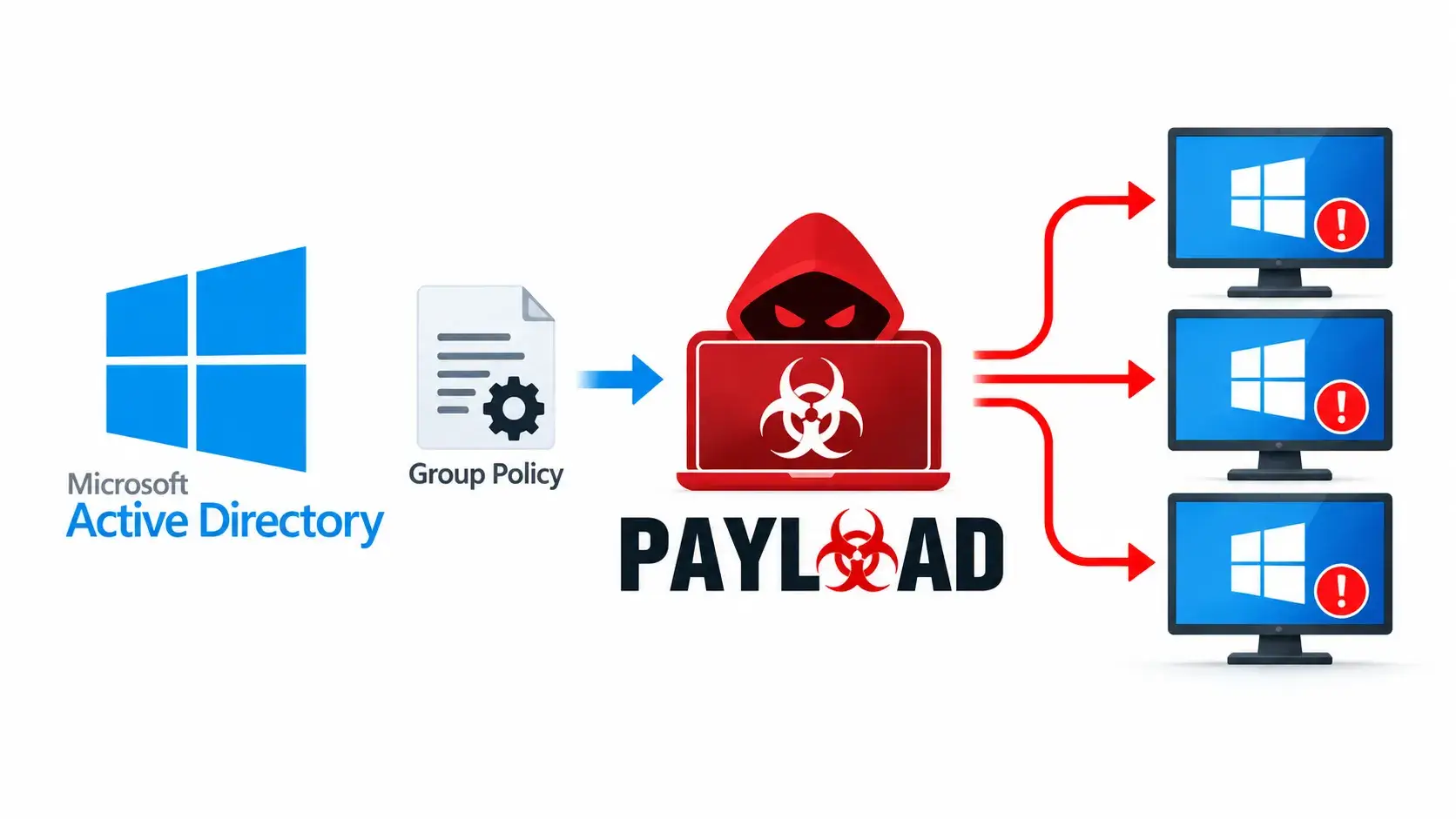
Security researchers have uncovered a novel ransomware campaign that sidestepped traditional payload delivery by leveraging Active Directory Group Policy to bring down an entire Windows domain, leaving no trace of encryption software on user machines.
The intrusion began in early April 2026 when threat actors gained entry to a corporate FortiGate SSL VPN using stolen domain credentials. Once inside the perimeter, the attackers escalated privileges and obtained the rights needed to edit Group Policy Objects (GPOs), a core component of Windows administration that propagates configuration changes across all joined computers.
Instead of installing a typical encryptor, the adversaries modified several GPO settings to disable critical services, block authentication mechanisms, and force a mass reboot of domain-joined endpoints. The coordinated changes rendered the network unusable within minutes, effectively achieving the same disruptive outcome as ransomware encryption while avoiding the forensic footprints that conventional malware leaves behind.
Group Policy abuse is not new, but its use as a ransomware delivery vector marks a significant evolution. By manipulating policies that are automatically applied by domain controllers, the attackers could execute their sabotage at scale without having to plant malicious binaries on each workstation. This approach also bypasses many endpoint protection solutions that focus on detecting executable payloads.
The affected organization reported extensive downtime across its internal applications, email services, and file shares. Because no ransomware ransom note or encrypted files were found, initial responders initially assumed a configuration error rather than a deliberate attack, delaying containment efforts. Once the true nature of the breach was identified, the incident response team had to manually revert the compromised GPOs and reset privileged accounts, a process that took several days.
Experts say the incident highlights the need for tighter monitoring of privileged changes within Active Directory and the importance of multi‑factor authentication for VPN access. Organizations are urged to audit GPO change logs, enforce least‑privilege principles for service accounts, and implement anomaly‑detection tools that can flag unusual policy modifications. As attackers continue to explore “living‑off‑the‑land” techniques, security teams must broaden their focus beyond malware signatures to include legitimate administrative functions that can be weaponized.



Comments (0)
Be the first to comment.
Join the discussion