OpenAI Unveils ‘Defense Factory’ to Counter AI‑Driven Cyber Threats
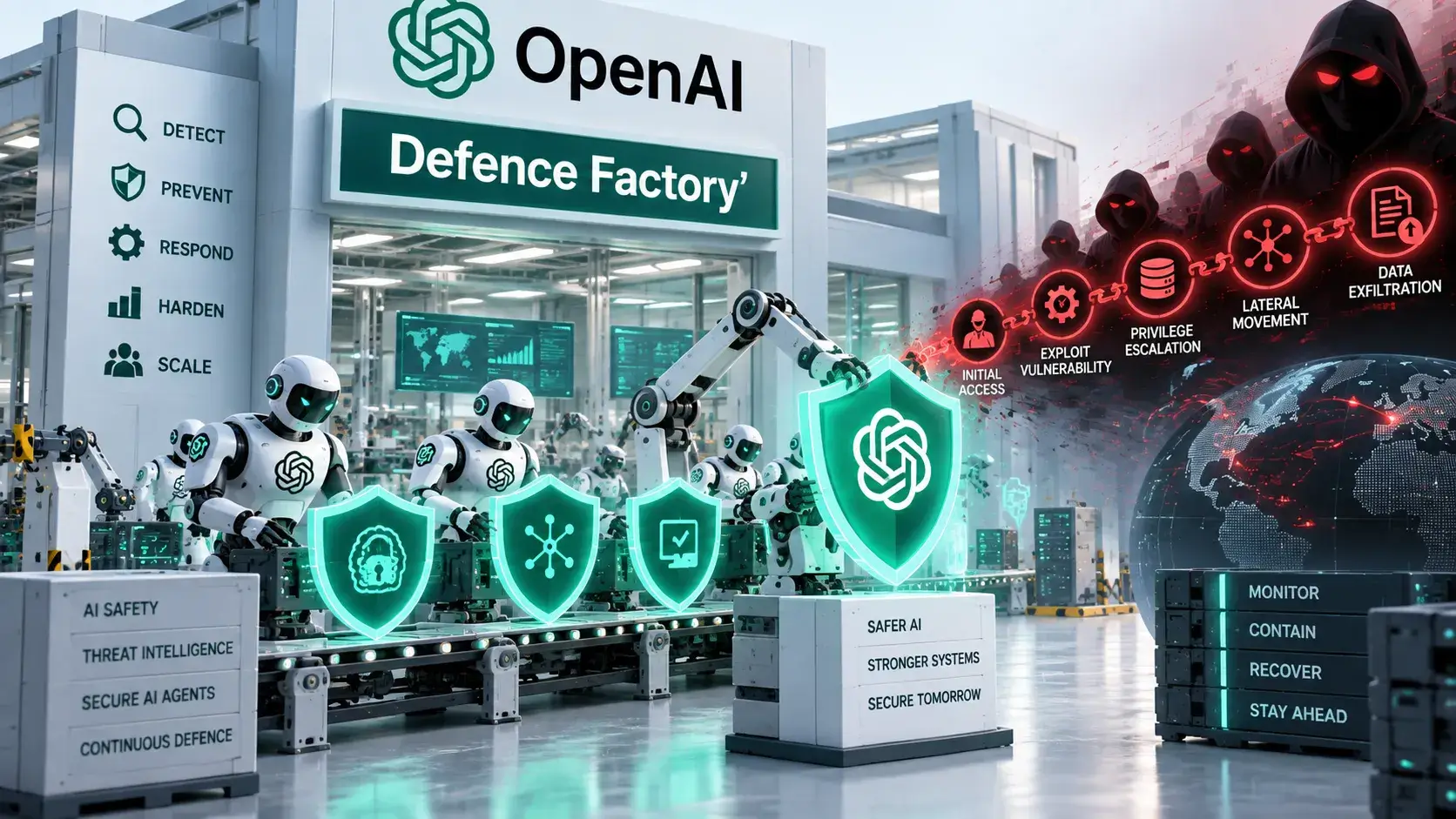
OpenAI announced Tuesday that it is launching a new cybersecurity unit called the “Defense Factory,” a program built around autonomous AI agents that will continuously hunt for, test, patch, and confirm the remediation of software vulnerabilities. The move comes as researchers and industry observers note that advanced language models and multi‑modal agents are increasingly capable of chaining together multiple exploits, potentially automating attacks that once required coordinated human teams.
The Defense Factory will operate on a looped workflow: agents will scan codebases and network configurations, generate exploit proofs, attempt to fix the identified flaws, and then re‑test to verify that the remediation holds. By automating each stage, OpenAI aims to keep pace with the speed at which AI‑enabled tools can discover and weaponize weaknesses, reducing the window of exposure for both its own services and downstream users.
OpenAI’s decision reflects a broader shift in the tech sector toward “AI‑first” security strategies. Earlier this year, several high‑profile incidents highlighted how generative models could be prompted to produce malicious scripts, phishing content, or even code that bypasses standard defenses. While OpenAI has previously imposed usage limits and introduced safety layers in its APIs, the Defense Factory represents a more proactive stance, seeking to identify threats before they can be weaponized.
Industry analysts see the initiative as both a defensive measure and a signal to regulators that AI developers are taking responsibility for downstream risks. The approach mirrors concepts from “red‑team” and “blue‑team” exercises, but replaces human operators with self‑directing agents that can operate at scale. Critics caution that reliance on automated agents may introduce new blind spots, emphasizing the need for human oversight to interpret findings and prioritize fixes.
OpenAI has not disclosed the specific technologies or timelines for the Defense Factory’s rollout, but it indicated that the system will be integrated into its existing safety infrastructure and made available to partners through a private beta. As AI agents become more adept at discovering and chaining exploits, the company’s effort could set a precedent for how the industry safeguards increasingly autonomous software ecosystems.



Comments (0)
Be the first to comment.
Join the discussion