Critical Docker ‘CopyEscape’ Flaw Lets Containers Tamper With Host Files
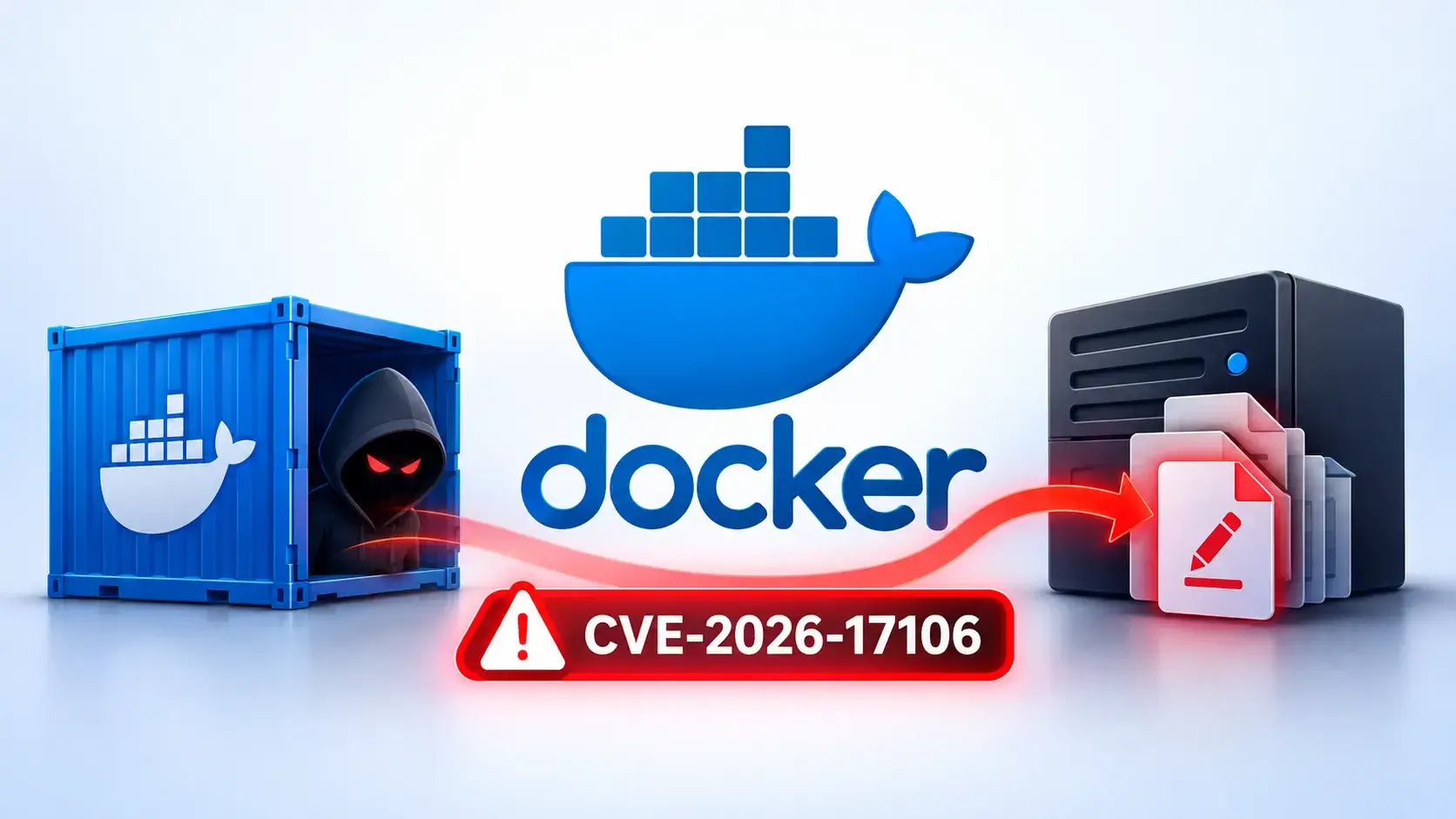
A newly disclosed vulnerability in Docker, catalogued as CVE-2026-17106 and dubbed “CopyEscape,” enables a malicious container to modify files on the host system when the docker cp command is used to copy data out of the container.
The flaw resides in Docker’s handling of copy‑out operations. When a user invokes docker cp to retrieve files from a container, the daemon fails to correctly validate the destination path on the host. An attacker who controls the container can craft a path traversal payload that points to arbitrary locations on the host filesystem, causing Docker to write the container’s data over existing host files.
Security researchers at GBHackers first reported the issue, noting that the vulnerability is classified as critical because it bypasses typical container isolation mechanisms. By overwriting configuration files, binaries, or scripts on the host, an adversary could achieve privilege escalation, persistence, or even full system compromise, especially on machines where Docker runs with elevated privileges.
Docker, which is widely used for packaging applications and microservices, has issued an advisory urging users to update to the latest patched version. The vendor’s response indicates that the fix tightens path sanitization in the copy‑out routine and adds additional checks to prevent directory traversal. Administrators are also advised to limit the use of docker cp in production environments and to apply the principle of least privilege to Docker daemon processes.
Industry analysts warn that the exploit highlights a broader trend of supply‑chain and container‑runtime attacks. While containers are designed to isolate workloads, vulnerabilities in the underlying runtime can undermine that separation. Organizations that rely heavily on Docker for CI/CD pipelines or for hosting critical services should review their security posture, conduct audits of container images, and monitor logs for unusual docker cp activity.
Looking ahead, Docker’s security team plans to introduce more granular auditing for file‑system operations and to expand community‑driven testing of runtime components. In the meantime, users are encouraged to apply the security update promptly, verify that their Docker installations are patched, and consider alternative methods for transferring data that do not rely on docker cp when handling untrusted containers.



Comments (0)
Be the first to comment.
Join the discussion