Critical Xcode Build Crash and Data Leak Vulnerability Found in Mach-O Archive Parser
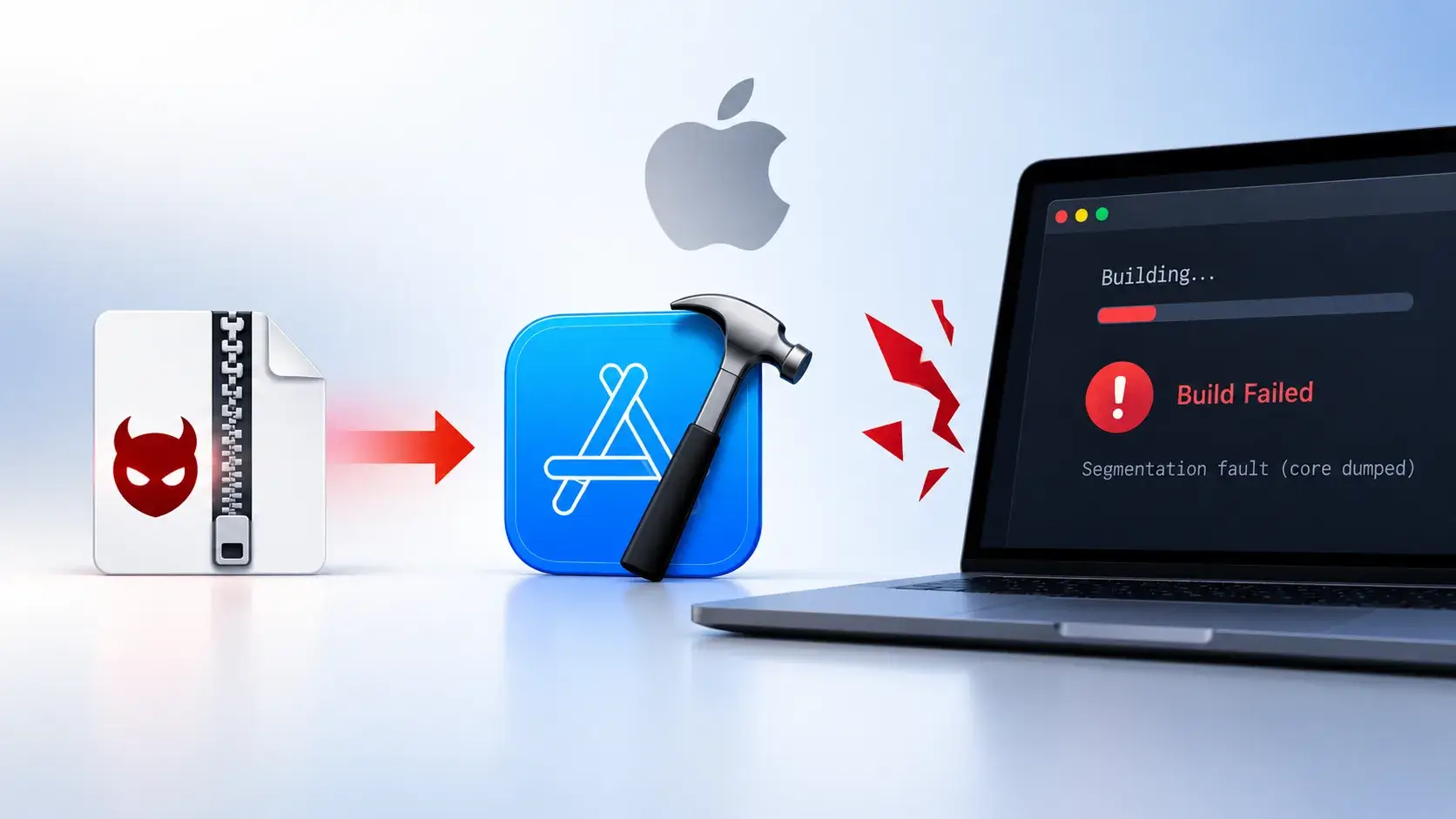
Security researchers have identified a serious integer underflow bug in the component of Apple’s development ecosystem that processes Mach-O archive files, a flaw that can cause Xcode builds to abort or inadvertently reveal portions of memory in build logs.
The vulnerability resides in the parser employed by Apple’s newer linker, ld‑prime, which handles modern static libraries packaged as .a archives. When a maliciously crafted archive contains specially sized entries, the parser’s arithmetic can underflow, leading to out‑of‑bounds memory access. The result is either a forced termination of the build process or the exposure of raw memory contents that may be written to the console or log files.
According to the original disclosure by the GBHackers group, the issue can be triggered by inserting a static library with manipulated header fields into a project’s dependency chain. Because Xcode automatically invokes the linker during compilation, any developer who includes such a library—intentionally or inadvertently—faces the risk of build instability or data leakage without needing to execute code on the target machine.
Apple’s modern Mach‑O handling was introduced to replace the legacy ld, promising faster link times and improved diagnostics. However, the transition also introduced new parsing logic that, as the researchers demonstrate, fails to correctly validate integer calculations when determining archive member offsets. This oversight is a classic example of an integer underflow, where subtraction of a larger value from a smaller one wraps around, producing an unexpectedly large positive index.
The practical impact is twofold. First, developers may see their builds crash with obscure error messages, potentially halting production pipelines. Second, because the linker often logs detailed information for debugging, the unintended memory dump could contain snippets of source code, environment variables, or other sensitive data, creating a privacy concern for teams that share build logs publicly or store them in continuous‑integration systems.
Apple has not yet issued an official statement, but the company typically releases patches through Xcode updates and macOS security bulletins. Security best practices advise developers to verify the provenance of third‑party static libraries, employ code‑signing checks, and keep their development tools up to date. Organizations using automated CI/CD pipelines should also audit build logs for unexpected content and consider sandboxing the build environment.
Industry observers note that this flaw underscores the broader challenge of securing the software supply chain, especially as modern development tools grow more complex. While the vulnerability is limited to the build phase rather than runtime execution, its ability to surface internal memory details can aid attackers in crafting further exploits against downstream applications.
The next steps are likely to involve Apple releasing a fix that adds stricter bounds checking to the ld‑prime parser. In the interim, developers are urged to monitor updates from Apple’s security advisory page and apply any patches promptly to mitigate the risk of build disruptions and inadvertent data exposure.


Comments (0)
Be the first to comment.
Join the discussion